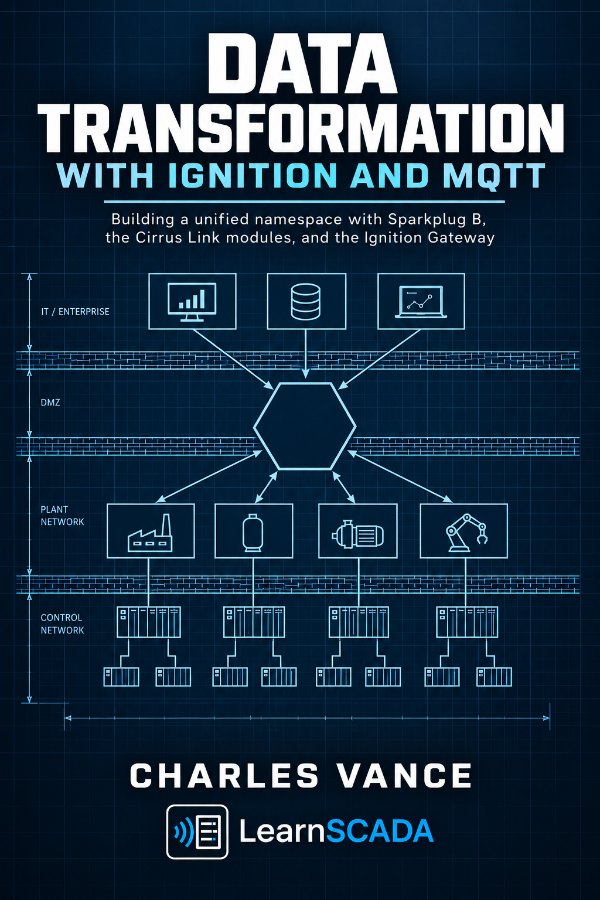
Data Transformation with Ignition and MQTT
Building a Unified Namespace with Sparkplug B, the Cirrus Link Modules, and the Ignition Gateway
Coming soon
Ask any plant what the OEE of Line 2 is right now, this minute, and somebody can get you an answer by the end of the shift. The filler PLC knew every bottle it ran. The historian logged it. The ERP had the schedule before the shift started. None of it was missing. What was missing was one place where it all came together, in one shape, with one set of names, that any application could simply read.
That gap is what this book closes, and it closes it by building rather than by surveying. Every chapter works on the same site, a bottling plant with two lines, a syrup room, and a utilities area, so the namespace, the edge nodes, the broker, and the consumers stay consistent from the first page to the last. You watch one design go in, and you see why each decision was made at the moment it had to be made.
Part I defines what data transformation is and why point-to-point integration stops scaling. Part II is a full treatment of Sparkplug B: the topic namespace, birth and death certificates, session state, metrics and templates, store and forward. Part III builds the system in Ignition, module by module, including UDTs mapped onto Sparkplug templates and a Gateway that normalizes four edge nodes into one site model. Part IV covers running it: TLS and access control, watching the wire, feeding the enterprise, and keeping the namespace under control as it grows.
What you will be able to do when you finish:
Design a namespace that survives a PLC replacement, a new line, and the engineer who comes after you
Configure and troubleshoot MQTT with real understanding of quality of service, retained messages, wills, and keep alive
Read a Sparkplug payload off the wire and say what every field is for
Build the whole stack in Ignition and know why each setting is where it is
Tell an operator, with confidence, whether the number on the screen is currently true
Written for integrators, controls engineers, SCADA administrators, and plant IT. If you can configure a PLC driver and read a tag browser, you have the background this assumes. Fully illustrated throughout with engineering drawings: architecture and loop diagrams, panel layouts, sectional cutaways, and charts.
- Author
- Charles Vance
- Category
- Ignition and SCADA