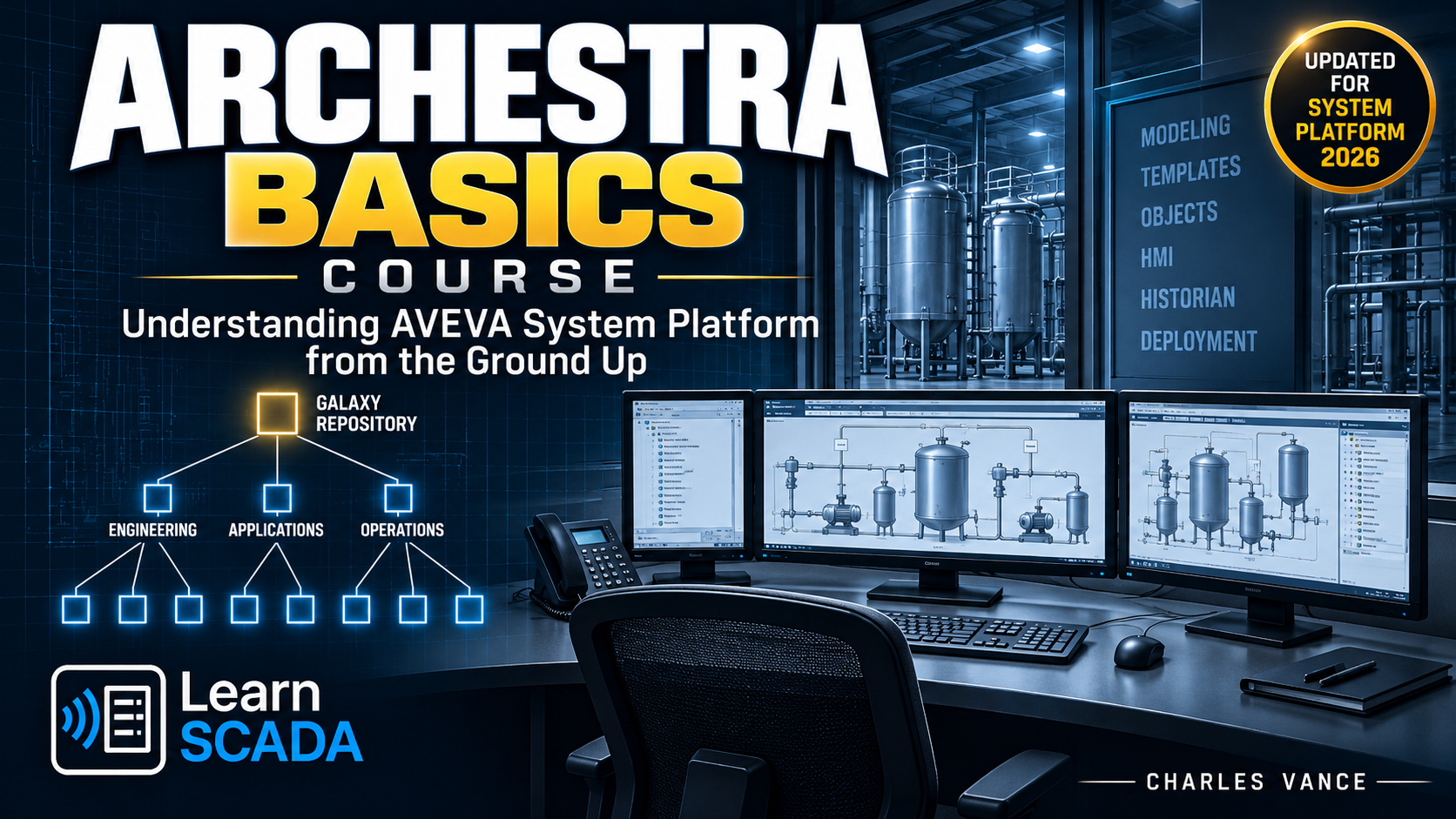
Archestra Basics
The interactive companion course to the book
Enrolling includes the book as a PDF download.
AVEVA System Platform models a plant as objects built from templates, not as a long list of tags. This course follows the book Archestra Basics chapter by chapter, from an empty Galaxy Repository to a secured, historized, two-client application on four lab nodes.
Each of the 25 chapters has animated figures you can play and pause, hands-on tools you use right in the browser, and a short check at the end.
- Templates, instances, locking, and containment, and why a change reaches some objects and not others
- Platforms, engines, areas, and the AppEngine scan, with a scan simulator
- QuickScript .NET, trigger types, and the ExecutionCnt guard pattern
- OI Servers, I/O references, quality, alarms, and history
- Industrial Graphics, owning objects, ShowGraphic, and the Symbol Wizard
- InTouch and OMI side by side: layouts, navigation, apps, web clients, and C# and Python methods
- Security, redundancy, change management, and troubleshooting by following the data
Written against System Platform 2026, with the changes since the 2014 release called out.
Includes the complete book as a PDF download.
Part I is free to preview.
Curriculum
Part I · The Platform
Part II · Building the Galaxy
- Platforms, Engines, and Areas
- User-Defined Objects and Attributes
- Scripting in Application Server
- Check-In, Deployment, and the Object Viewer
Part III · Connecting to the Plant
- OI Servers and Device Integration Objects
- I/O References, Field Attributes, and Quality
- Alarms, Events, and the Area Hierarchy
- History and Publishing the Model to MQTT
Part IV · Industrial Graphics and InTouch
- The Industrial Graphic Editor
- Owning Objects, References, and ShowGraphic
- The Symbol Wizard
- InTouch ViewApps and WindowMaker
Part V · Operations Management Interface
- What OMI Is and How It Differs from InTouch
- Building an OMI ViewApp: Layouts and Panes
- The Navigation Model, Content Presenter, and Roles
- OMI Apps: Graphic Repeater, Trends, Alarms, and Maps
- Web ViewApps and Multi-Screen Deployment
- Scripting OMI in C# and Python
Part VI · Running It
- Security, Users, and Roles
- Redundancy, Backup, and Change Management
- Commissioning, Troubleshooting, and the Diagnostics Manager
Reference
- Quick Reference (Appendices A???B and Glossary)